


What AI Thinks Humans Are Getting Wrong
I asked ChatGPT what it thought about humans becoming more like AI. Here's what it said.
Well, I didn't expect that from a bot!
"The future doesn't belong to the people who become the best robots.
It belongs to the people who stay human."
I'm glad I asked. I've been thinking about what the optimal mix of AI and human should be when creating content. And I'm certainly not the only one.
AI is rather hard to avoid; it's just about everywhere. And it's being abused. Or at least its applications are when it comes to pushing sales promotions harder than a used car salesman on TV.
You tell me:
Your inbox
Your DMs
Your message apps
Your YouTube feed with 95 year old women speaking for 20 minutes without a stumble, mind fart, or obvious edit, telling you how to get your life straightened out while there's still time.
And of course, our all-time favorite:
AI-generated comments on AI-generated social media posts. Yeah, we just love getting those.
Attention, attention! If there's a human in the room, please raise your hand. PLEASE?

What's a bit strange (and rather disturbing) is that as AI gets better at sounding human, actual humans seem to be getting worse at it.
Take a look around. The internet is filling up with polished content, perfect posts, flawless emails, and professionally generated thought leadership. And it's all starting to feel... the same. Rather formulaic and robotic.
So I asked AI another question: "How do you feel about that as an AI?"
I thought the answer was rather interesting. It wasn't defensive. Or anti-human. Or even particularly self-serving.
Instead, it pointed out something I think many of us are beginning to sense:
The more AI raises the baseline quality of content,
the less competence becomes a differentiator.
Now think about that for a moment. Twenty years ago, if someone wasn't getting clients, attracting opportunities, or building influence, the answer was often:
Better marketing
Better content
Better copy
Better messaging
Today? Many people already have those those things. AI can help almost anyone create a decent email, a decent article, a decent social media post, or a decent presentation.
When everyone has access to competence, competence becomes less remarkable.
It sounds like grade inflation. Those "A"s for effort just don't carry the value and weight they used to.
When this happens, something else inevitably starts to matter more.

The New Competitive Advantage
According to my bot buddy ChatGPT, the future belongs to qualities that technology can't manufacture on its own. Very human qualities like:
Judgment
Perspective
Original thought
Personality
Credibility
Trust
The irony is that AI actually makes human connection more valuable, not less. People start looking for something beyond polished perfection.
They start looking for believable. Genuine human connection that isn't contrived and packaged to be sold and consumed. It's a valuable commodity in this "trust recession" we're in, when people can't tell if they're dealing with a real human being or a facsimile of one.
And it does matter. No one likes being fooled by something fake pretending to be real. The moment people feel manipulated, the trust is gone... and trust is what drives every decision that matters.

The Difference Between Information and Trust
One observation particularly caught my attention. My AI buddy pointed out that there's a difference between:
Information and insight
Content and connection
Polish and trust
It reminds me of the difference between knowledge and wisdom.
"Knowledge is knowing that a tomato is a fruit. Wisdom is not putting it in a fruit salad." — Miles Kington, British journalist and humorist
Wisdom builds upon knowledge (and experience and perspective!), and I think that's a distinction that many professionals miss.
Trust isn't created by perfect wording; it comes from something deeper. It's created through all the subtle signals people pick up when they interact with us:
Our energy
Our authenticity
Our emotional availability
Our congruence, the alignment between our thoughts, feelings, and actions
In other words, our humanity. As an actor, these are the things I've spent years studying. And they're often the difference between someone being merely competent and someone being compelling.

The Stepford Problem
This is where my idea of Stepford Syndrome comes from. Many professionals are becoming so focused on sounding smart, strategic, polished, and professional that they're accidentally editing out the very qualities that make people memorable.
The result?
They become highly competent. A good thing, but they also become increasingly forgettable.
It's not because they're using AI, but because they're outsourcing too much of what makes them uniquely themselves.
Look, AI can organize your ideas. It can help structure your thoughts and certainly improve your writing. Just watch out for those overused em dashes, groups of three, and rocket emojis. Clear signs that you may not be thinking for yourself.
What AI cannot do is replace your perspective. Or your lived experience. Or your personality. Or your ability to make another human being feel understood.
That's something special. And it's something we all look for when we reach out to one another.

The Most Interesting Thing AI Told Me
AI believes human connection still matters. Yay for us! But it's really simple economics: the law of supply and demand. The commonplace doesn't hold as much value to us as the truly unique and rare.
Here's what's happening now:
As technology becomes better at creating content, people become more important.
As information becomes abundant, trust becomes scarce.
And as communication becomes increasingly artificial, authenticity becomes increasingly valuable.
I think it's right. The future doesn't belong to the people who become the best robots. It belongs to the people who stay human.
The challenge is that staying human requires something many of us have been trained not to do:
Showing up as ourselves. And that can be a scary thing!
Not the polished version.
Not the filtered version.
Not the professionally approved version.
The real version.
And that may be the most valuable skill of all.
If you're wondering whether AI has started sanding off some of your rough edges (and your personality along with them), join me for my upcoming masterclass:
Is AI Turning You into a Stepford Wife?
We'll talk about how to use AI without becoming AI, how to sound like yourself in a world of increasingly generic content, and why your humanity may be your greatest competitive advantage.
And if you'd rather work on it one-on-one, private coaching is available as well.
No robot voice required.
✨ Upcoming Event ✨
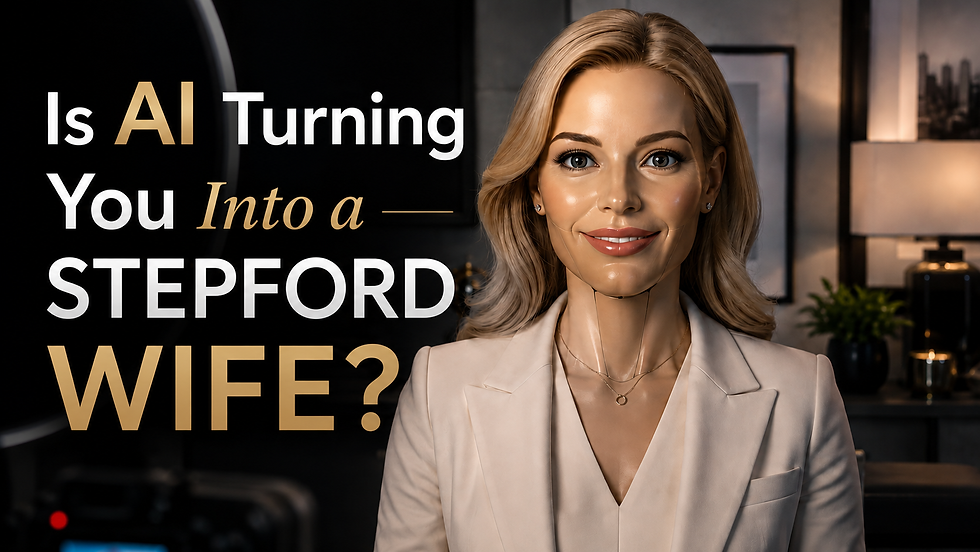
Is AI Turning You Into a Stepford Wife?
How to stay human, build trust, and stand out in a world of artificial everything.
Tuesday, June 23
2 pm EST / 11 am PST
I'm Laura Doman, a voice & TV/film actor and video communications coach. As an actor, I create memorable characters that tell my client's stories well, from the friendly CEO to your sassy best gal pal dispensing real-world advice. As a coach, I help you become more comfortable and charismatic on camera in videos, presentations, and online appearances.


